


The late February sunshine has turned our hills a vibrant green, making it the perfect time for hiking. Unfortunately, it’s also the exact moment tick season explodes in our area.
It is late February in the North Bay. The heavy winter rains have moved on, leaving behind a spectacular reward: our iconic, rolling hills have transformed from their dormant brown into a vibrant, lush green. The mustard flowers are blooming in the vineyards, and the temperatures are finally inviting us back outside.
Whether you are hitting the trails in Marin, walking the dogs in Sonoma, or just enjoying your own backyard in Benicia, this is arguably the most beautiful time of year in Northern California.
However, this explosion of green brings a hidden, microscopic threat. As the grasses shoot up and the wildlife becomes more active, we are officially entering peak tick season in the North Bay.
The Hidden Hitchhiker: The Western Black-Legged Tick
While we have several species of ticks in California, the most concerning is the Western Black-legged Tick. This is the primary vector for Lyme disease in our region.
A common misconception is that ticks jump from trees or fly through the air to land on you. In reality, their hunting method is much more patient—and much creepier. It’s called “questing.”
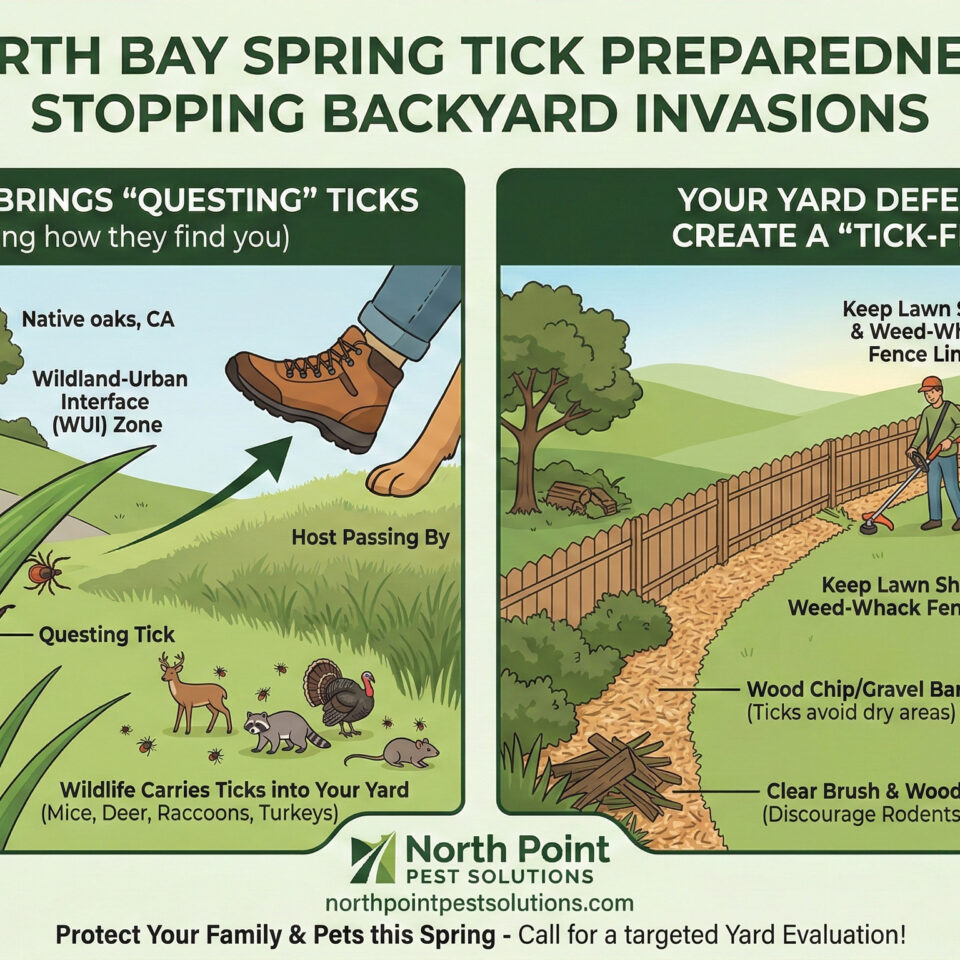
Ticks climb to the top of long blades of green grass or the edges of low-hanging shrubs. They hold onto the leaf with their lower legs and reach their hook-like front legs out into the air. When a hiker, a dog, or a deer brushes past that blade of grass, the tick simply grabs on and hitches a ride.
The Threat in Your Own Backyard
It is easy to assume that ticks are only a problem if you are deep in the woods of Mount Tamalpais or hiking through Annadel State Park. But if you live in the North Bay, the threat is often right in your own backyard.
Many of our neighborhoods are built on the Wildland-Urban Interface (WUI)—meaning our manicured lawns often back right up to wild, unmanaged open spaces, hillsides, or creeks.
The ticks don’t walk into your yard on their own. They are carried in by the local wildlife. Deer, raccoons, turkeys, and especially field mice wander out of the wild brush and into your garden, dropping fully fed ticks into your landscaping. When those ticks lay eggs, your backyard suddenly becomes a breeding ground.
Your Late-Winter Yard Defense Plan
Before the spring grass gets any higher, take these proactive steps to make your property hostile to ticks:
- Create a “Tick Zone” Barrier: If your yard borders wild grass or woodland, create a 3-foot-wide barrier of wood chips or gravel between the wild edge and your lawn. Ticks are susceptible to drying out and rarely cross hot, dry barriers to get to your grass.
- Keep It Short: Mow your lawn frequently. Weed-whack the tall, invasive grasses that shoot up along your fence lines and retaining walls during this late-winter growth spurt.
- Manage the Mice: Because the Western Fence Lizard and wild deer mice are the primary carriers of nymphal ticks, rodent control is tick control. Clear out brush piles, fallen leaves, and stacked wood where mice like to nest.
- Pet Inspections: Your dog is a tick magnet. After a walk, check them thoroughly, paying special attention to the areas under their collar, behind their ears, and between their toes.
Reclaim Your Outdoor Space
You shouldn’t have to worry about your kids or pets picking up a dangerous parasite just by playing in the backyard.
If your North Bay property borders open space, heavy brush, or a creek, standard landscaping might not be enough. North Point Pest Solutions offers specialized, targeted perimeter treatments that create an invisible barrier around your property, eliminating ticks before they can establish themselves in your lawn.
Enjoy the beautiful green hills safely this spring. Contact us today for a yard evaluation!