


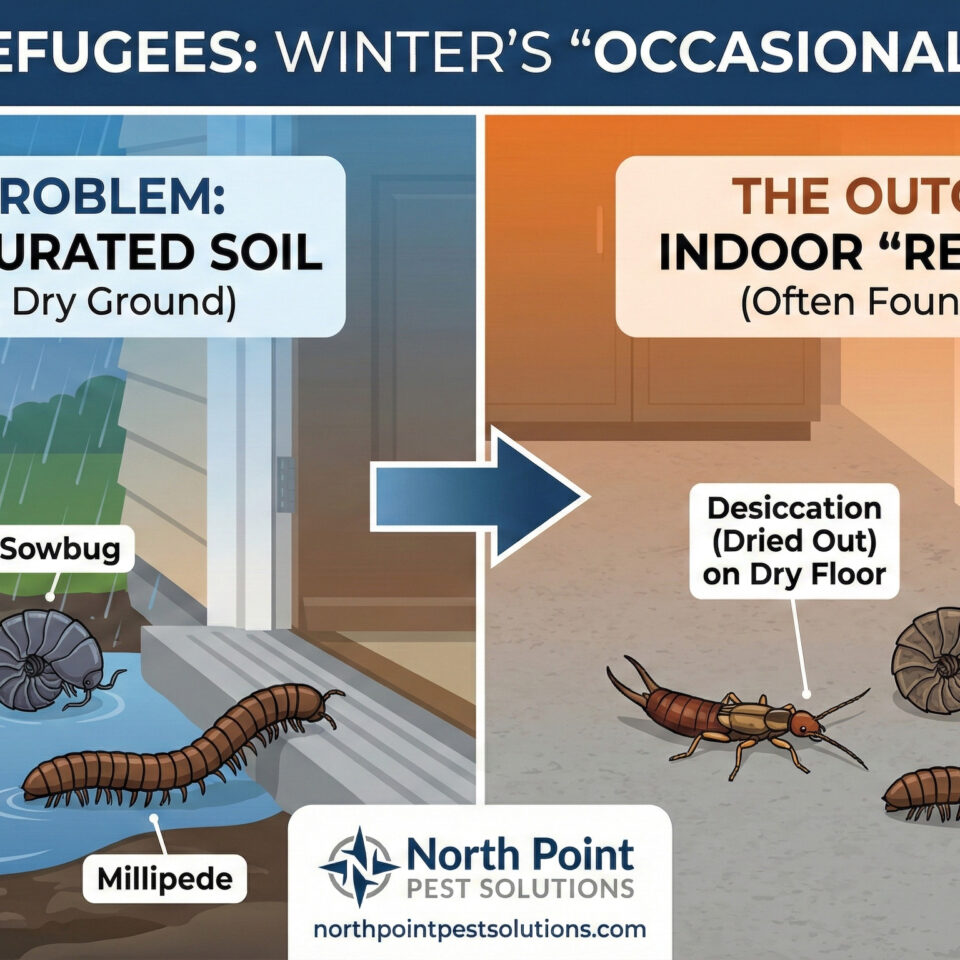
The soil in is saturated. Now, the creatures that live in it are seeking higher ground—which happens to be your garage and living room floor.
It is the first week of February. By now, the ground here in the greater North Bay is thoroughly soaked. After weeks of intermittent rain, the soil has reached what we in the industry call “saturation point.” The sponge is full; it cannot hold any more water.
While this is great news for our reservoirs, it creates a crisis for the millions of tiny creatures that live in the topsoil and mulch around your home.
If you have walked into your garage, mudroom, or bathroom this week and found yourself stepping on a curled-up millipede or dodging a scurrying earwig, you are witnessing a mass migration. These aren’t pests looking for food; they are refugees looking for dry land.
Unlike the ants or rodents we discussed in January (who move in for warmth), these pests are simply trying not to drown.
The “Occasional Invaders”
In the pest control world, we group these critters together as “Occasional Invaders.” They don’t want to live in your house permanently—it’s usually too dry for them—but they are forced inside by environmental pressure.
Right now, three specific invaders are likely crossing your threshold:
1. The Earwig (The Pincher Menace) Easily the most reviled of the bunch, the European Earwig is famous for its ominous-looking pincers (forceps) on its tail.
- The Myth: No, they do not crawl into human ears to lay eggs in brains. That is an old wives’ tale.
- The Reality: They are scavengers that love damp, decaying plant matter. When the mulch outside gets flooded, they squeeze under your door. While their pincers can give a mild pinch if handled, they are not dangerous. They are, however, unsightly and tend to congregate in large, creepy groups under rugs or cardboard boxes in the garage.
2. Sowbugs and Pillbugs (The “Land Shrimp”) Did you know that Roly-polies (pillbugs) and Sowbugs aren’t actually insects? They are crustaceans. They are more closely related to shrimp and lobsters than they are to ants. Because they breathe through gill-like structures, they require high moisture to survive. However, they cannot survive being underwater.
- Why they are inside: Your garage floor offers the perfect compromise: damp enough to breathe, but dry enough not to drown.
3. Millipedes These are the worm-like decomposers with two pairs of legs per body segment. When the soil floods, millipedes often migrate in massive numbers. You will typically find them curled into tight spirals on your tile floors.
The “Dead Zone” Mystery
You might have noticed that you often find these pests dead a few feet into your home. You wake up, walk down the hallway, and see a dried-up millipede or sowbug.
This happens because your home is actually too dry for them. They enter to escape the flood, travel a few feet onto your carpet or hardwood, and their bodies rapidly lose moisture (desiccation). They essentially dry out before they can find a way back outside.
Finding them dead is a good sign that your home is dry, but it’s still a mess you don’t want to clean up every morning.
How to Stop the Migration
Since these pests are entering at ground level, the defense is all about your perimeter.
- Check the Door Sweeps: This is the #1 entry point. If you can see daylight under your exterior doors, an earwig can walk right in. Replace worn-out rubber sweeps on all exterior doors, especially the one leading to the garage.
- Clear the Perimeter: Pull back mulch, wet leaves, and ivy at least 6-12 inches from your foundation. This creates a “dry zone” that discourages them from congregating right against your house.
- Seal the Sliding Tracks: Sliding glass doors are notorious for having weep holes that allow bugs in. Ensure your brush seals are intact.
When Nuisance Becomes a Problem
While these pests don’t eat your house like termites or spread disease like rats, they can be indicators of moisture issues. If you are finding live earwigs or sowbugs deep inside your home (in bathrooms or kitchens), it may indicate you have a leak or a moisture problem in your walls that is sustaining them.
Don’t let your home become a lifeboat for the garden’s bugs. If the sweeping and sealing aren’t enough, North Point Pest Solutions can apply a targeted perimeter barrier that stops the migration before it reaches your door.
Keep the outdoors… outdoors. Contact us today!