


When the sun finally breaks through the winter chill, overwintering wasp queens wake up to go real estate hunting. Here is how to stop their empire before it starts.
Welcome to late February in the North Bay! We are currently in that confusing seasonal window often referred to as “False Spring.” The heavy rains pause, the sun comes out, and the temperature creeps into the low 60s. We step outside to enjoy the sunshine—and unfortunately, so do the most aggressive pests of the summer.
If you notice a very large, surprisingly sluggish wasp buzzing groggily around your roofline, patio, or fence this week, don’t ignore it. That isn’t a leftover worker from last year. That is a Queen.
Understanding what these queens are doing right now is the ultimate “hack” for a sting-free summer.
The Biology of the Overwintering Queen
Unlike honeybee colonies that survive the winter by huddling together for warmth, yellowjacket and paper wasp colonies die off completely when the first hard frost hits in late autumn. The only survivors are the newly fertilized queens.
These queens spend the winter in a state of diapause (hibernation). They tuck themselves into tight, insulated spaces: inside your attic vents, under the loose siding of your house, deep in woodpiles, or under the bark of mature trees.
When the late February sun warms the exterior of your house, it acts as a biological alarm clock. The queens wake up hungry, thirsty, and with one single mission: to build a new empire.
The Real Estate Hunt
Right now, these queens are solitary. They aren’t aggressive, and they aren’t looking to sting you; they are focused purely on real estate. They are scouting for the perfect, sheltered location to build a small “starter nest.”
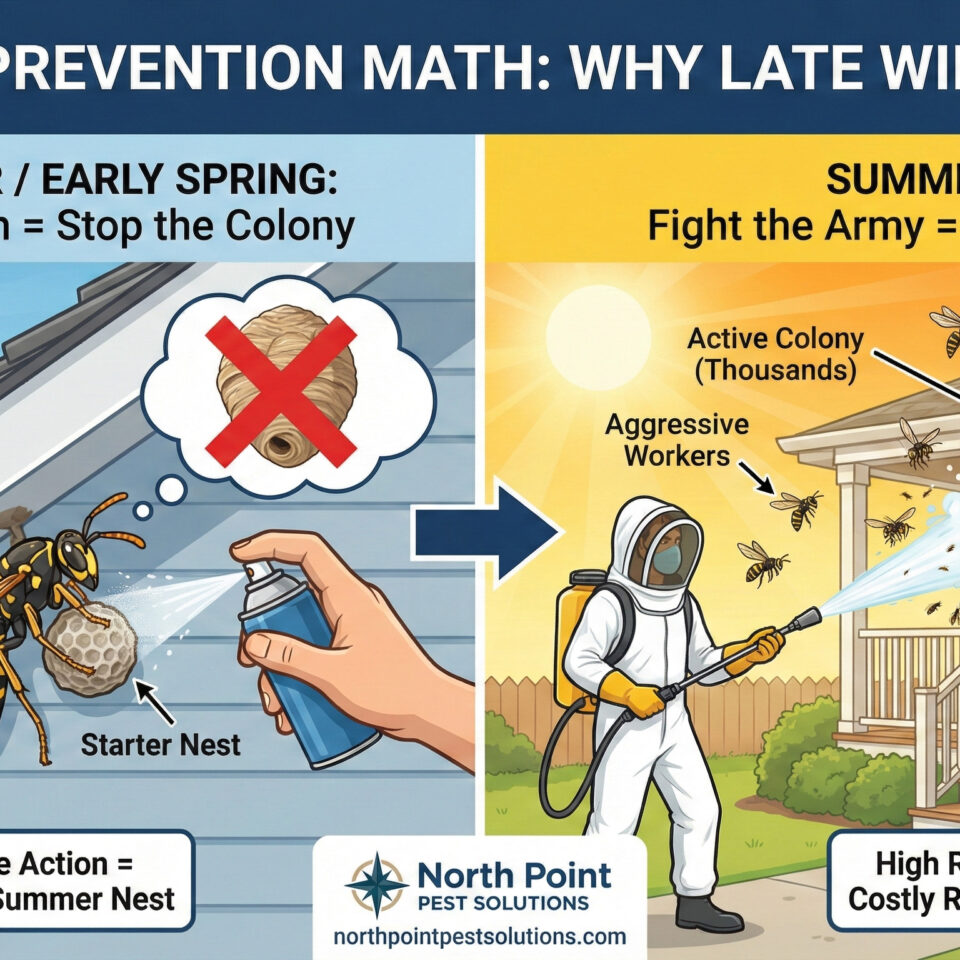
Once she finds a spot—often tucked under a roof eave or inside a quiet shed—she will chew wood fibers to create a tiny, golf-ball-sized paper nest. She lays her first batch of eggs and hunts for caterpillars to feed them. Once this first generation of “worker” daughters matures in a few weeks, the queen retires to the nest permanently to lay eggs, while the workers take over construction and defense.
The Math of Prevention
Why is it so critical to take action right now? It comes down to simple math.
If you swat a wasp in August, you have eliminated one worker out of a nest that likely contains anywhere from 500 to 5,000 angry, stinging insects.
If you eliminate a groggy queen in late February or early March, you have eliminated the entire future colony. Preventing a nest from being built is infinitely easier, safer, and cheaper than trying to eradicate a massive, deeply entrenched yellowjacket nest from your wall voids at the height of summer.
Your Late-Winter Action Plan
Take advantage of the sunny days this week to do a preventative sweep of your property:
- Look Up: Walk the perimeter of your house and look at the eaves, patio covers, and the corners of your window frames. If you see a queen starting a tiny nest, knock it down immediately with a broom while she is away, or use a targeted wasp spray.
- Inspect Wall Voids: Yellowjackets love to nest inside the walls of homes. Look for large wasps flying in and out of small cracks in your stucco, damaged foundation vents, or gaps around utility pipes.
- Seal the Envelope: If you find gaps where siding meets the roofline, seal them with exterior-grade caulk now before a queen decides it’s the perfect front door for her new home.
- Early Trapping: Hardware store yellowjacket traps (the kind with the pheromone attractant) are highly effective right now. Hanging one on the perimeter of your yard in late February can trap the scouting queens, stopping the life cycle in its tracks.
Don’t Wait for the Swarm
A single wasp flying around your roofline today is a warning sign of a massive problem waiting for you in July.
If your home has a history of yellowjackets or paper wasps, or if your property has high rooflines and eaves that are difficult to inspect, don’t wait for the workers to hatch. Contact North Point Pest Solutions today. We can perform a thorough early-spring perimeter sweep to ensure your home remains a no-fly zone all summer long.