


You expect ants at your summer BBQ, but in your January bathroom? Here is why winter rain and cold drive Argentine ants into Benicia homes.
It is mid-January in the North Bay. The holidays are officially behind us, the decorations are stored away, and we are settling into the rhythm of the new year. Outside, it’s chilly, damp, and likely raining.
You walk into your kitchen to make a warm cup of coffee, or step into the bathroom to brush your teeth, and you see it: a dark, moving line of ants marching across the counter.
It’s a confusing sight. We are conditioned to think of ants as a “summer problem”—creatures that crash 4th of July picnics and raid spillages on warm patios. So, why are they invading your home when it’s 45 degrees outside?
If you live in Benicia or the surrounding area, you aren’t imagining things. Winter ant invasions are incredibly common here, and it has everything to do with our unique climate and the specific biology of our most common pest: the Argentine Ant.
The “Flood or Freeze” Effect
While many insects go fully dormant in winter, Argentine ants are opportunistic. Their colonies are massive, often linking multiple nests together in “super-colonies” that can span entire neighborhoods.
The soil around your home is their natural habitat. However, January weather in Northern California presents two major threats to them, both of which lead them straight to your door:
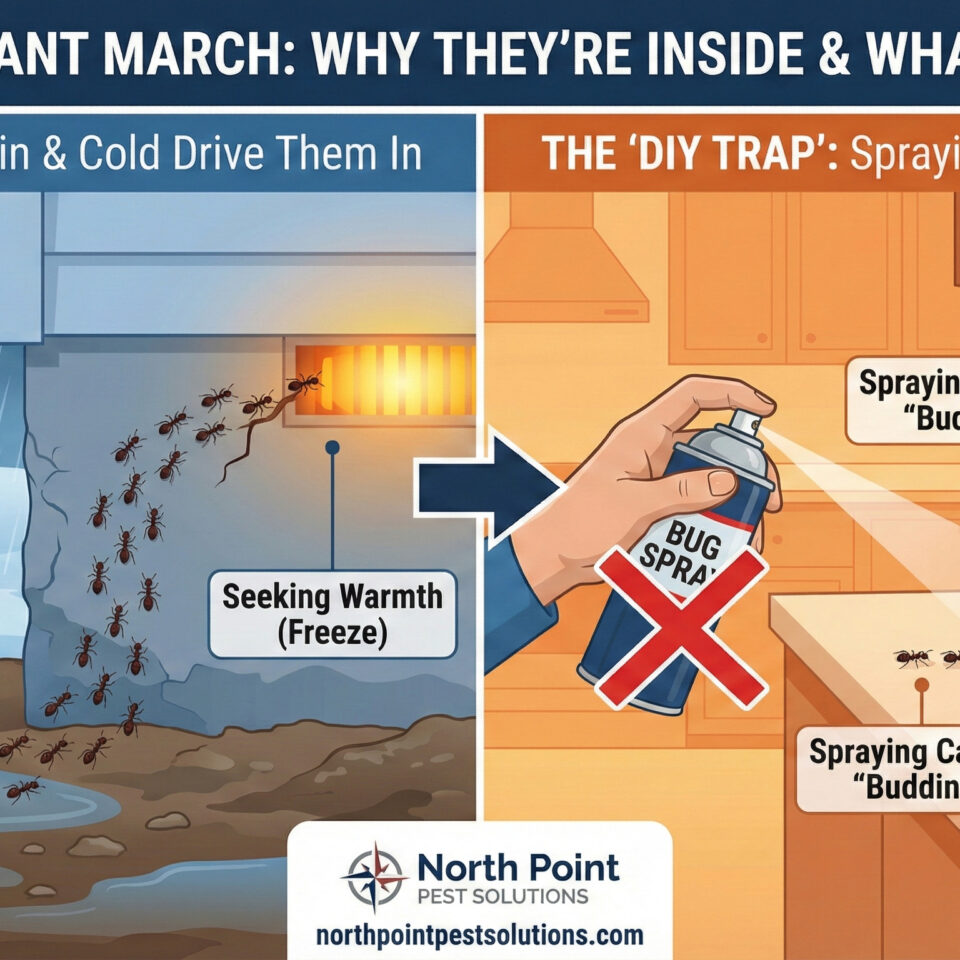
- Soil Saturation (Rain): When we get heavy winter rains, the ground becomes saturated. Just like humans seeking high ground during a flood, ant colonies that live underground are forced upward to escape drowning. Your home’s foundation, walls, and subfloors offer the perfect “dry island” in a sea of mud.
- The Deep Chill: While they can tolerate cool weather, deep frosts or prolonged cold snaps slow them down significantly. Your home creates a “heat halo.” They can sense the warmth radiating from your vents, water heater, and appliances. They move inside not necessarily for food, but for the warmth required to keep the colony active.
The DIY Trap: Why Spraying Makes It Worse
When homeowners see that trail of ants in the kitchen this week, the instinctive reaction is to grab a can of aerosol bug spray and blast the line.
Please, put the can down.
Spraying Argentine ants is often the worst thing you can do. These ants possess a unique defense mechanism called “budding.”
When you spray a toxic repellent on a line of worker ants, the stress signal is sent back to the colony. The queens (and Argentine ant colonies have many queens) perceive a threat. Instead of dying off, the colony splits. One large nest divides into three or four smaller satellite nests to ensure survival. They move into different walls or different rooms.
By spraying, you might kill the fifty ants on your counter, but you have just turned one centralized problem into a multi-room infestation that is much harder to treat.
How to Stop the Winter Invasion
To handle winter ants effectively, you have to outsmart them, not just out-spray them.
- Follow the Trail (Don’t Erase It): Before you clean up the ants, watch them for a few minutes. Where are they coming from? They are likely trailing along a baseboard, a window frame, or entering through an electrical outlet. Identifying the entry point is key for professional treatment.
- Remove the “Bridges”: Go outside (if it’s not pouring rain) and check the perimeter. Are there tree branches touching the roof? Is there ivy or shrubbery growing against the siding? These plants act as highways for ants to bypass the wet ground and enter your home through the eaves.
- Eliminate Moisture: Since they are often seeking a balance of moisture and warmth, check under your sinks. A slow leak in the P-trap or a damp bathroom mat can act as a magnet for a colony seeking water.
The Professional Solution
Because Argentine ants have such massive, multi-queen colonies, the only way to truly stop them is with non-repellent transfer treatments. This involves using specialized products that the ants do not detect. They walk through it, pick it up, and unknowingly carry it back to the nest, sharing it with the queens. This collapses the colony from the inside out—no “budding” required.
If you are waking up to uninvited guests this January, don’t let them get comfortable. Contact North Point Pest Solutions. We know the behavior of local ants and how to reclaim your kitchen without making the problem worse.